

Grocery spend is heavily concentrated around payday – no surprises there. But when we split the month into two fortnightly segments, directly after payday and before the next payday, we notice some key trends that have meaningful implications for grocery retailers looking to reverse their current performance.
Even though grocery spending is concentrated around payday, the timing of that specific day has an impact on trends. In our data, the 25th is the most common payment date for salaries, but the 24th, 20th and 15th are also popular.
And what about the specific day of week? That also has an impact on where spending is loaded. For example, payday on a Friday affects spend differently to payday on a Monday.
Therefore, for this report, we defined a ‘payday cycle’ that starts on the 25th of the month, or the Friday before when the 25th falls on a weekend, and runs for 28 days.
We then partitioned the spending analysis into two fortnightly blocks, focussing on the primary grocery retailers: Boxer, Checkers, PnP, Spar, Shoprite and Woolworths. (For Woolworths, note our usual caveat: we don’t distinguish food from clothing purchases, even though three quarters of Woolworths spending is on food.)
Let’s start at the top and drill deeper…
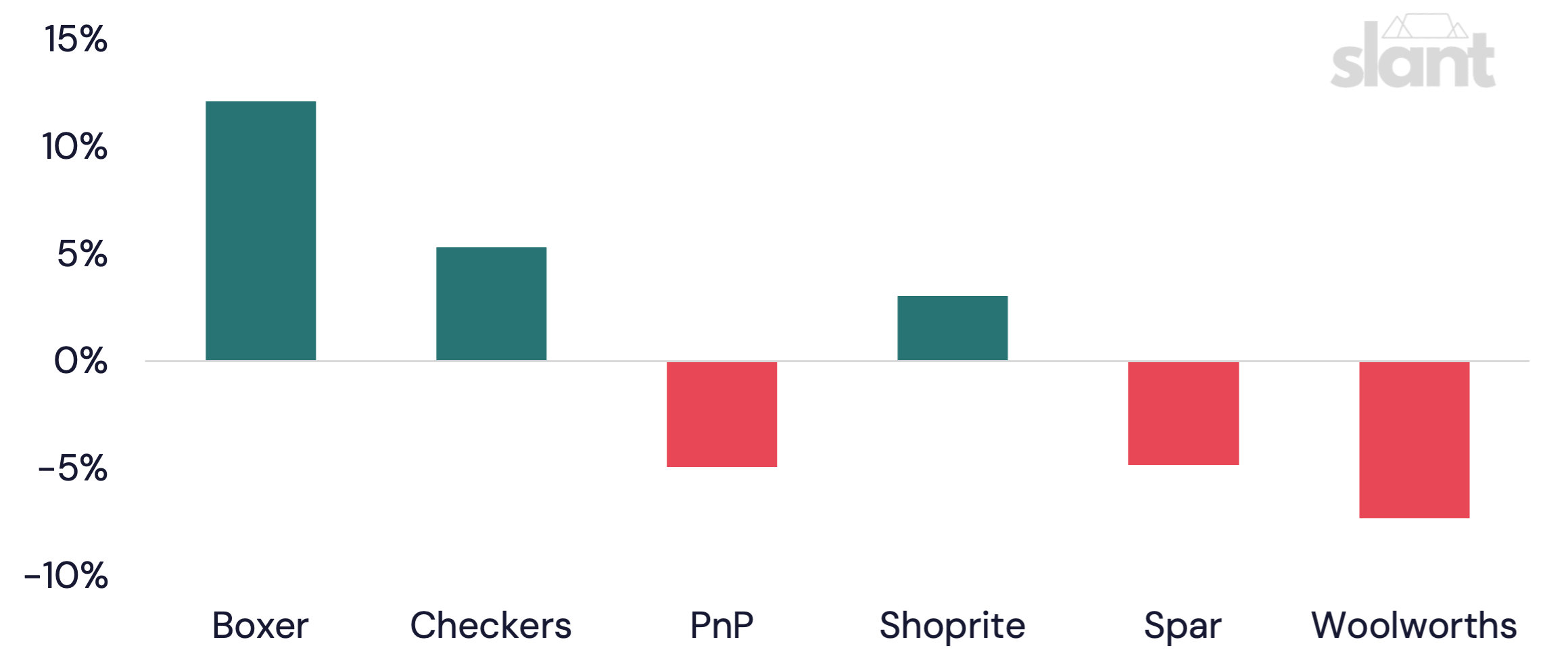
As we’ve reported before, Boxer, Shoprite and Checkers have increased their share of spending over the past year. PnP, Spar and Woolworths have lost share to compensate.
These movements – for the six months ending July 2026, compared to 2025 – are shown below.
Growth in market share: 2026 vs 2025
In addition to this, we can show that the value of spending in the first two weeks of the payday cycle disproportionately contributes to total monthly spend. This is true for retailers across the board. As an example, customers spend twice as much at Boxer in the first two weeks of the payday cycle as they do in the second two weeks. And the contribution of spending in the first fortnight after payday has increased compared to last year.
Multiple of spending
Value of spending in first half of payday cycle, compared to second half
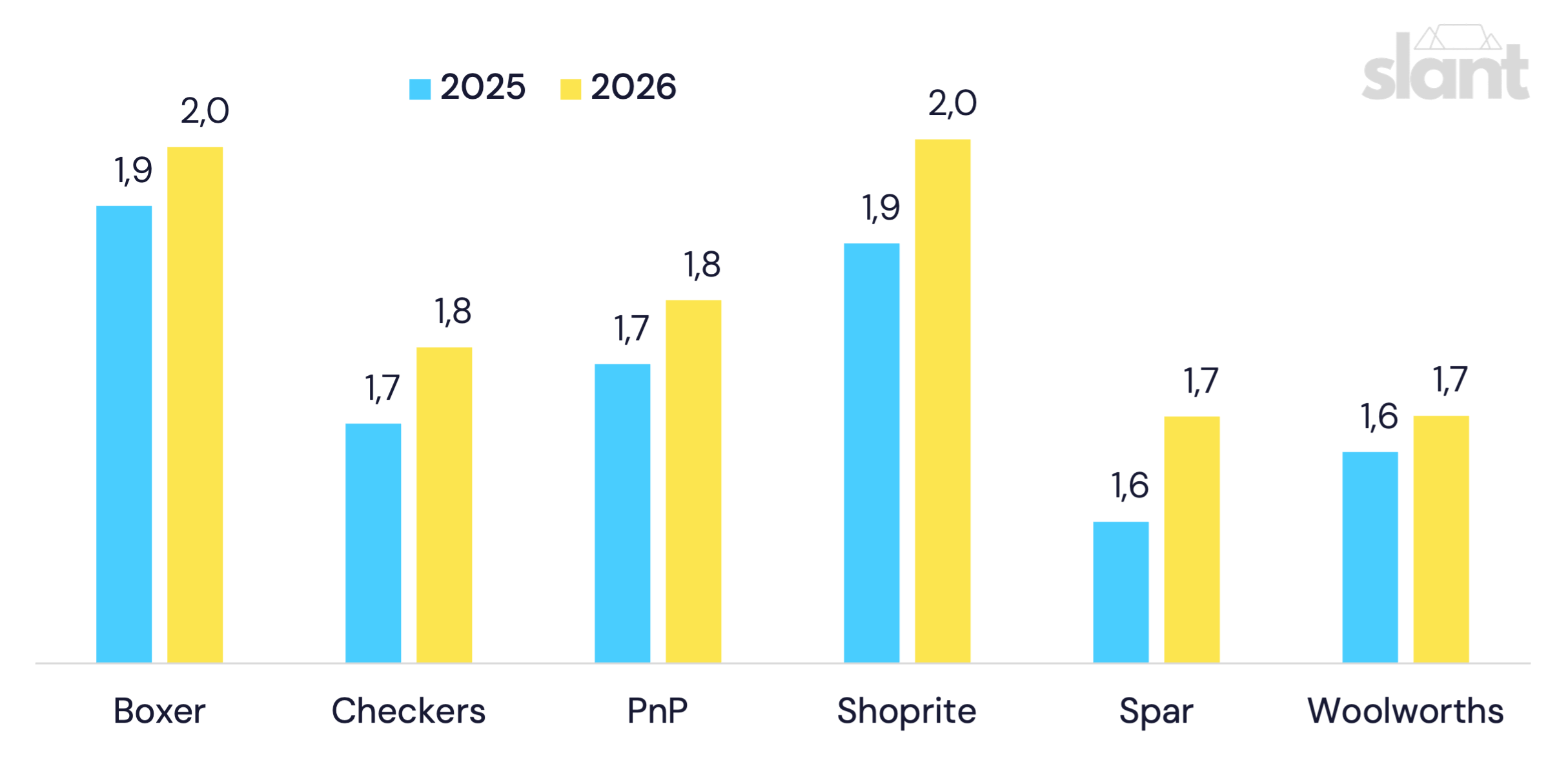
Because of this, change in market share can mostly be attributed to shifts in the first two-week period, compared to the second two weeks. In other words, winning in the first half of the payday cycle is crucial.
You need to be logged in to read further.
If you are a client, please reset your password and login using your corporate e-mail address.
Slant offers solutions for investors, corporates and data partners. Click the button below to get in touch and find out how our alternative data and class-leading research can help you.